Approach

Pedagogical adaptability is my forte

Technology should widen who gets to take part, not narrow it.

I design creative, digital‑first and student‑centred learning environments, with a particular focus on responsible AI, employability, sustainability and inclusive practice. My work spans curriculum design, academic staff development, enterprise education and AI literacy.

What connects it is a belief that learning design has to be adaptable. Subject expertise does not go out of date, but the tools around it change constantly — so the job is to help colleagues and students distinguish what endures from what evolves, and to build environments where experimenting with new tools feels safe rather than risky.

I use playful and participatory methods, including LEGO® Serious Play®, sketch‑noting and concept mapping, because they surface what people actually think — particularly in rooms where hierarchy or uncertainty would otherwise keep people quiet.

Recognition

  • National Teaching Fellow (NTF), awarded 2026 — the UK’s national recognition for excellence in teaching and learning in higher education
  • Senior Fellow, Advance HE (SFHEA)
  • Social Programme of the Year 2025, Global Sourcing Association Awards — for embedding mental health literacies through innovative pedagogy
  • University Teacher Fellow, awarded 2023
  • Economics Network Best Lecturer in the UK Award, 2021
  • Faculty of Business & Law Rising Star Award, 2020
  • Nominated, Student Choice Teaching Awards — 2022, 2023 and 2025

Professional roles

  • Mentor and Assessor for Advance HE Fellowships
  • Associate (appointed) of the UK’s Economics Network
  • Associate Editor, International Journal of Organizational Analysis
  • Member, CIPR AI in PR Panel
  • Certified LEGO® Serious Play® Facilitator and Carbon Literate Educator
Academic Innovation project, 2023–24

Enhance your subject specialism by embracing AI creatively

The project set out to develop enhanced approaches and roadmaps for leveraging AI in ways that align with staff’s subject specialisms — addressing specific learning objectives, enabling personalised learning, promoting critical thinking and supporting student engagement, while keeping a strong connection to educators’ own expertise.

How it worked

  • A thorough review of existing pedagogical practices
  • Brainstorming sessions — ‘What does AI mean for you?’ — with both academic and professional staff across faculties
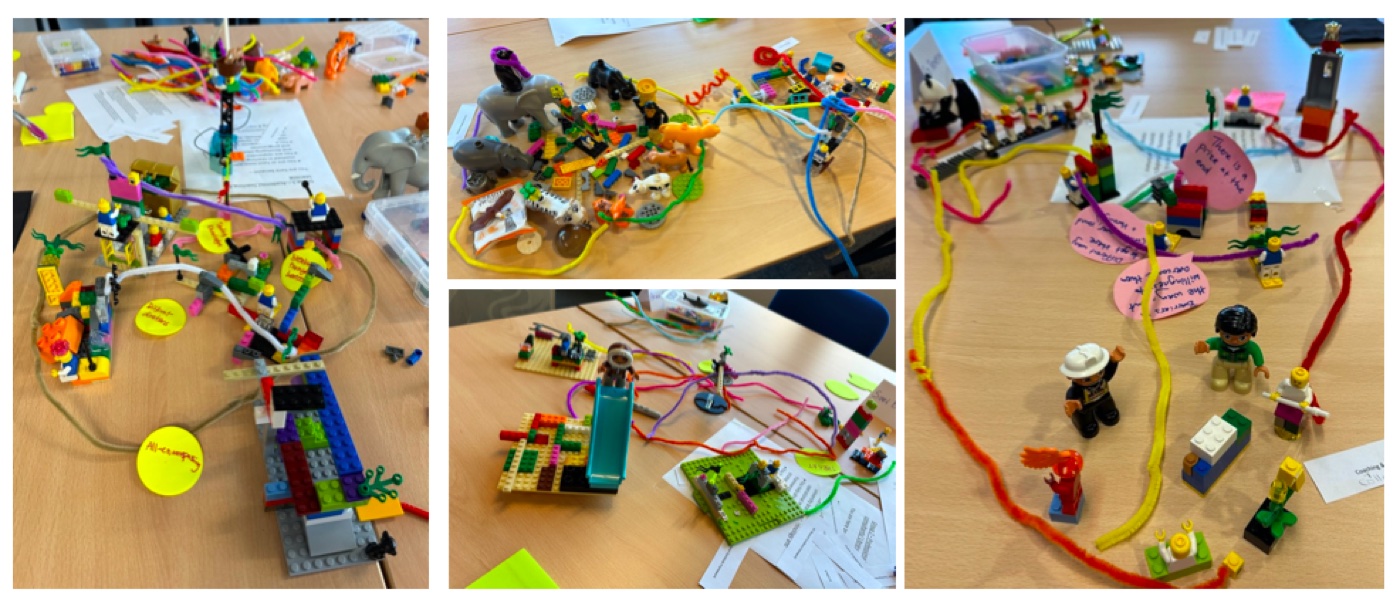
  • Innovative facilitation techniques, including LEGO® Serious Play®
  • Iterative drafting of frameworks, tested with staff
  • Production of a faculty‑wide AI ‘Scaffolded Approach’
Three photographs of LEGO Serious Play workshop models built by staff on tables, using coloured bricks, minifigures and pipe cleaners, with handwritten sticky notes attached.
LEGO® Serious Play® sessions with academic and professional staff.
Outputs

Frameworks developed through the project

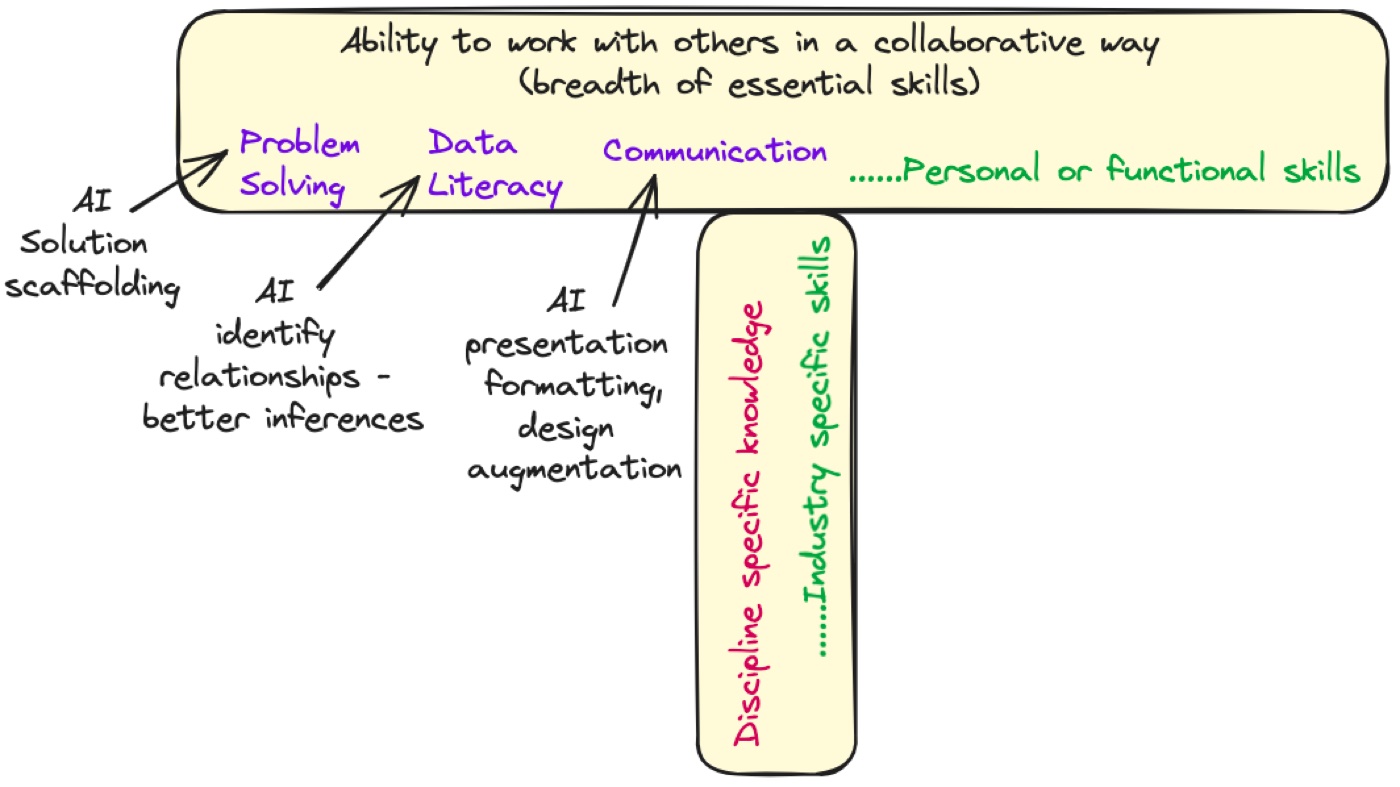
AI solutions embedded in the T‑Shaped Competency framework

The T‑shaped model describes a professional with deep discipline‑ and industry‑specific knowledge (the vertical stroke) and a breadth of essential collaborative skills (the horizontal). This adaptation maps where AI genuinely augments the horizontal — solution scaffolding for problem solving, identifying relationships for better inferences in data literacy, and presentation formatting and design augmentation in communication.

The point is deliberate: AI supports the breadth, but it does not substitute for the depth.

Diagram of a T-shaped competency framework. The horizontal bar is labelled 'ability to work with others in a collaborative way — breadth of essential skills' and contains problem solving, data literacy, communication and personal or functional skills. The vertical bar contains discipline-specific and industry-specific knowledge. Arrows point into the horizontal bar showing where AI helps: solution scaffolding for problem solving, identifying relationships for better inferences in data literacy, and presentation formatting and design augmentation for communication.
AI solutions mapped onto the T‑Shaped Competency framework.

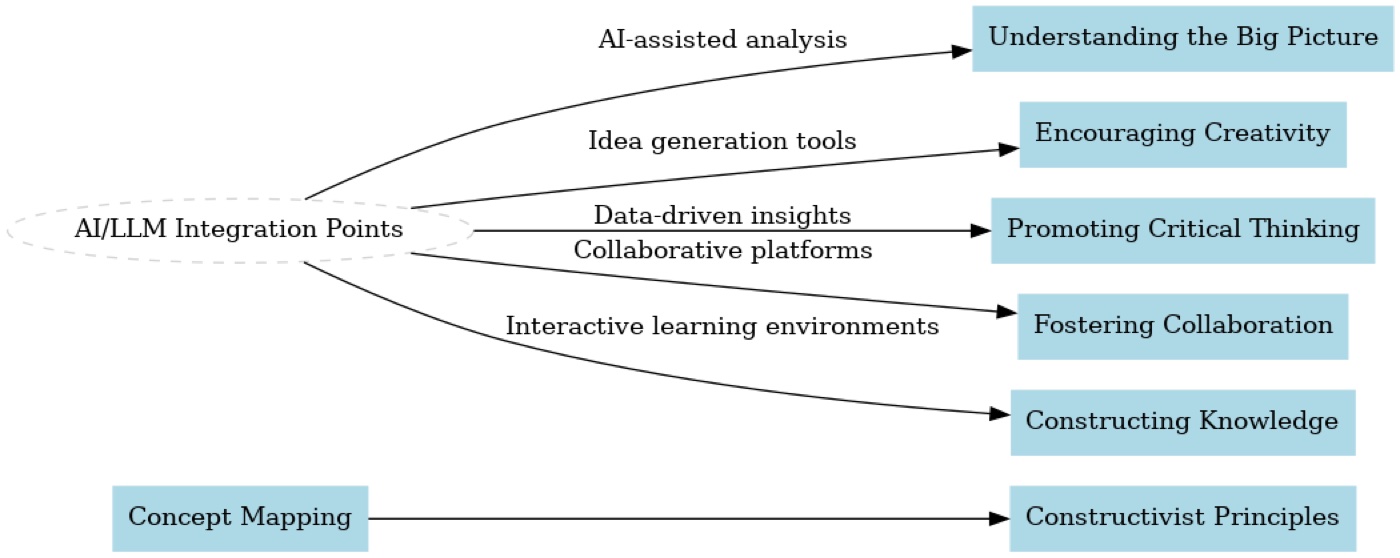
Concept mapping AI integration points

A concept map linking AI and large language model integration points to the learning outcomes they serve: AI‑assisted analysis for understanding the big picture, idea generation tools for encouraging creativity, data‑driven insights for promoting critical thinking, collaborative platforms for fostering collaboration, and interactive learning environments for constructing knowledge — all anchored in constructivist principles.

Concept map with AI and large language model integration points on the left connected by labelled arrows to five outcomes: understanding the big picture via AI-assisted analysis, encouraging creativity via idea generation tools, promoting critical thinking via data-driven insights, fostering collaboration via collaborative platforms, and constructing knowledge via interactive learning environments. A separate row links concept mapping to constructivist principles.
Mapping AI integration points to learning outcomes.

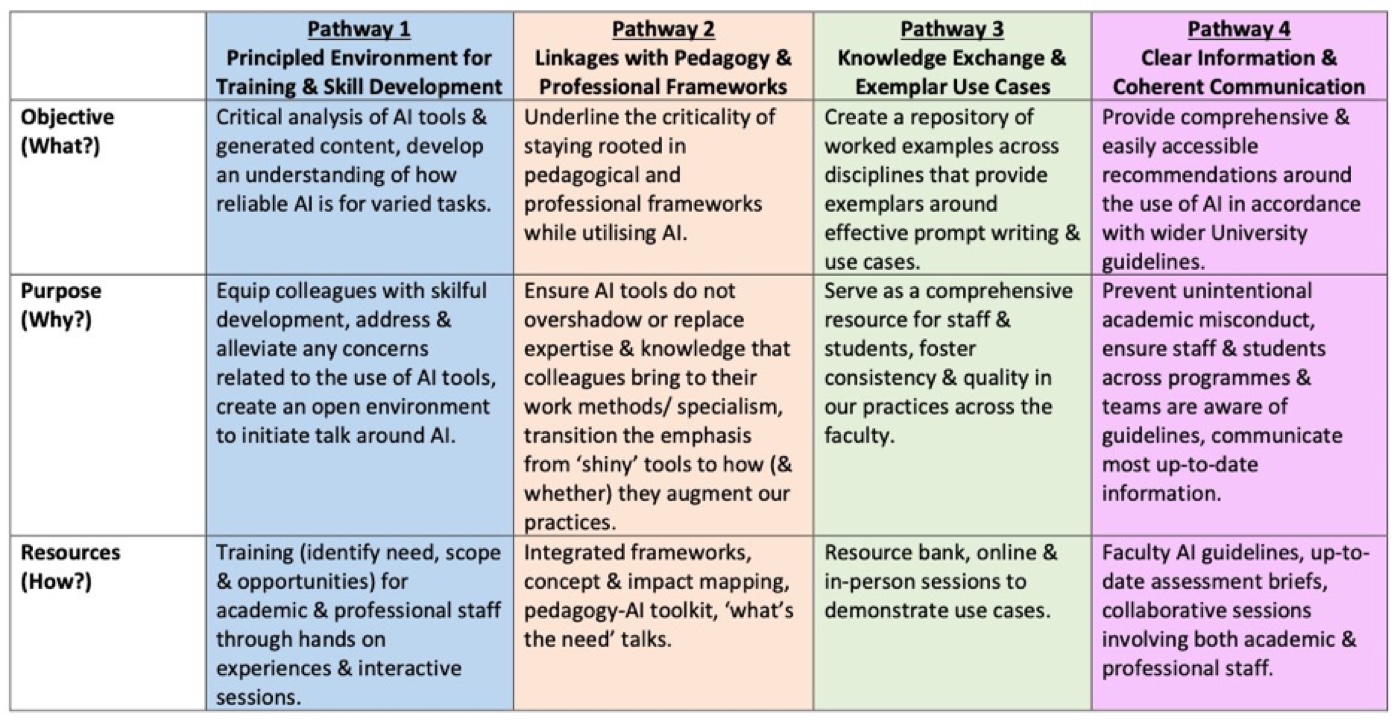
The faculty‑wide Scaffolded Approach

The main output: a four‑pathway approach that gives a whole faculty a shared route into AI, with each pathway defined by its objective, its purpose and the resources needed to deliver it.

  • Pathway 1 — A principled environment for training and skill development. Critical analysis of AI tools and generated content, developing an understanding of how reliable AI is for varied tasks, and creating an open environment for talking about AI.
  • Pathway 2 — Linkages with pedagogy and professional frameworks. Keeping AI use rooted in pedagogical and professional frameworks, so tools do not overshadow the expertise colleagues bring, and shifting the emphasis from ‘shiny’ tools to whether and how they augment practice.
  • Pathway 3 — Knowledge exchange and exemplar use cases. A repository of worked examples across disciplines showing effective prompt writing and real use cases, fostering consistency and quality.
  • Pathway 4 — Clear information and coherent communication. Accessible recommendations aligned to wider university guidelines, preventing unintentional academic misconduct and keeping staff and students current.
Table setting out the faculty-wide scaffolded approach to AI across four pathways, with rows for objective, purpose and resources. Pathway one covers a principled environment for training and skill development; pathway two covers linkages with pedagogy and professional frameworks; pathway three covers knowledge exchange and exemplar use cases; pathway four covers clear information and coherent communication.
The four‑pathway Scaffolded AI Integration Approach.
Curriculum & strategy

Design work at programme and portfolio level

DMU London Digital Strategy

A three‑point strategy for embedding AI literacy across an entire academic portfolio — sustainability, static versus dynamic skills, and modules as a digital marketplace.

See the strategy

Pedagogy‑Technology Toolbox

A practical resource pairing pedagogical intent with the technology that actually serves it, rather than the other way round.

New curriculum areas

MSc Responsible Data Analytics and MSc Cyber Security & AI, designed from market insight and employer demand — so that responsible practice is part of the subject, not a bolt‑on module.

Global Cities MBA

A distinctive programme designed for shared delivery across the London and Dubai campuses, developed as part of my portfolio leadership.

EDGE and career development

A bespoke skills‑development programme and the London Career Development Service, launched as part of embedding employability and employer partnership into the campus.

Carbon Literacy

Leading the integration of Carbon Literacy across student and staff activity, supporting the campus towards Silver Carbon Literate Organisation accreditation.

Playful & participatory learning

Creative storytelling in economics with LEGO and AI, and the use of participatory methods to support deeper learning and staff development.

Read the case studies
Doctoral supervision

Research students

I supervise doctoral candidates working at the intersection of technology, organisations and education, and welcome enquiries from prospective students in these areas.

  • Customer experience in the era of Artificial Intelligence

    Adib Rachkidi

  • Towards a sustainable framework for the management of Transnational Education (TNE)

    Lawrence D’Souza

Staff development

Bringing this to your institution

I run staff development sessions, curriculum design workshops and facilitated LEGO® Serious Play® workshops on AI literacy, assessment in the GenAI era and inclusive pedagogy.