• Human-Centred AIDesigning systems around lived experience, agency and inclusion.
  • Ethics-by-DesignResponsibility built into how AI is imagined, developed and evaluated.
  • AI GovernanceFrameworks that make ethics and accountability operational.
  • Digital GoodTechnology that reduces rather than widens inequality.

Conversational AI · Inclusion · Live pilot

SCOPE‑AI: Listening Differently

Conversational AI for inclusive feedback, civic engagement and lived experience research

  • PartnerRAFT, a Leicestershire charity supporting parents and carers of care‑experienced children
  • StatusIn pilot
  • FundingDMU Mary Seacole Research Centre Grant (2025)
  • ThemesDigital inclusion, participatory research, mental health literacy

SCOPE‑AI is an intelligent survey agent that reimagines data collection as a guided, adaptive dialogue rather than a static form or survey. Developed with inclusion at its core, it helps people share their experiences in their own words, ask for clarification where they need it, and move at their own pace.

The RAFT trial explores how conversational AI can support more accessible, nuanced and inclusive feedback gathering — particularly from groups whose voices can be missed through traditional survey methods, where written responses, language barriers or confidence limit engagement.

SCOPE is deliberately designed not to collect personal or sensitive data, and to support safe, respectful and meaningful engagement. The wider aim is to test how conversational AI can make research and consultation genuinely more participatory.
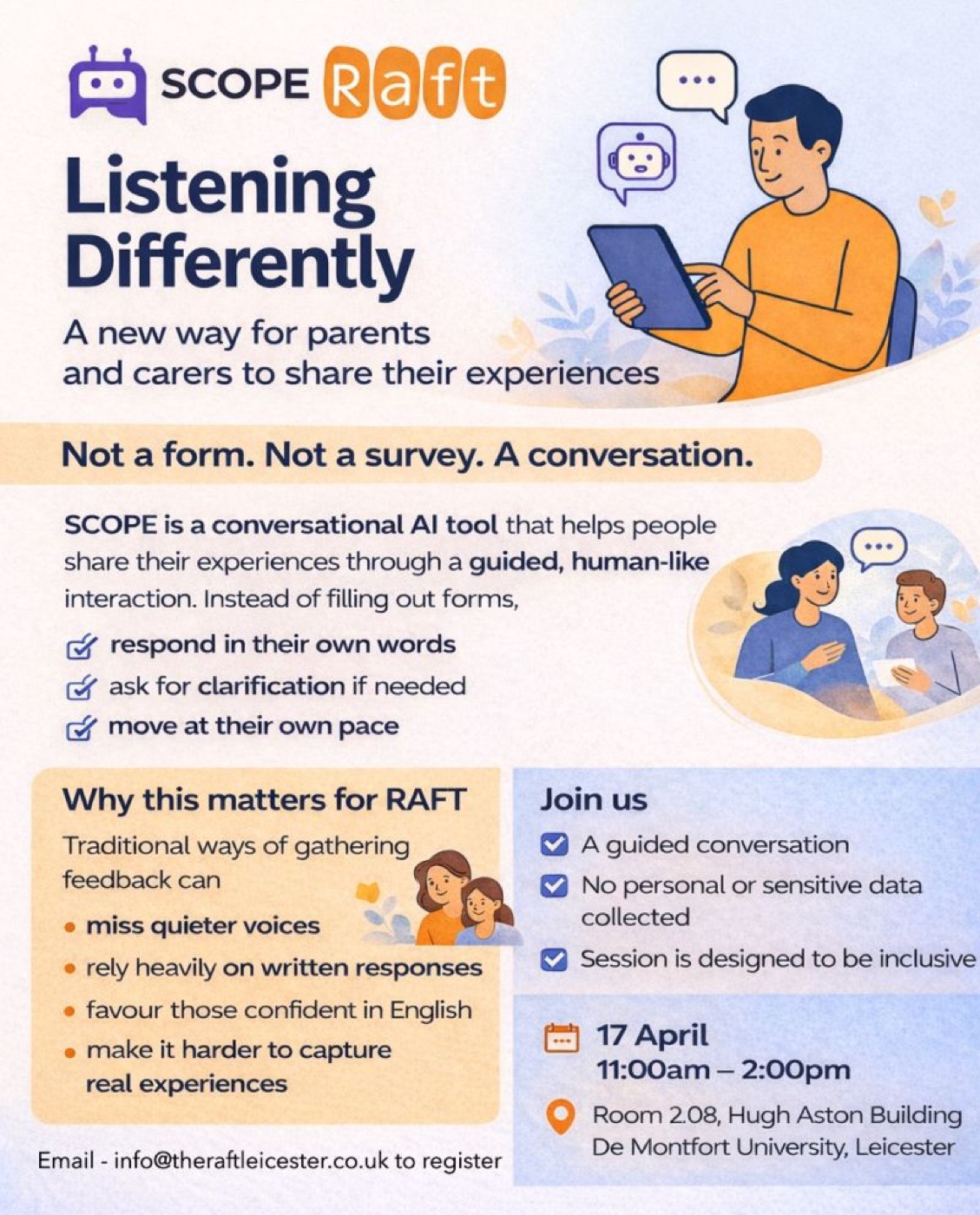
Flyer for the SCOPE and RAFT session, headed 'Listening Differently — a new way for parents and carers to share their experiences'. It explains that SCOPE is a conversational AI tool where people respond in their own words, ask for clarification and move at their own pace, and confirms that no personal or sensitive data is collected.
Participant flyer for the RAFT pilot — ‘Not a form. Not a survey. A conversation.’

AI governance · Public sector

Responsible AI Governance with University Hospitals of Leicester NHS Trust

Embedding ethics, strategy and accountability into AI adoption

  • PartnerCommunications and Engagement Directorate, University Hospitals of Leicester NHS Trust
  • OutputProactive responsible AI governance framework
  • ThemesAI governance, public service communication, ethics‑by‑design

This project responds to a central challenge facing public‑sector organisations: how do you adopt AI in ways that are innovative, useful and efficient, while remaining transparent, accountable and aligned with organisational values?

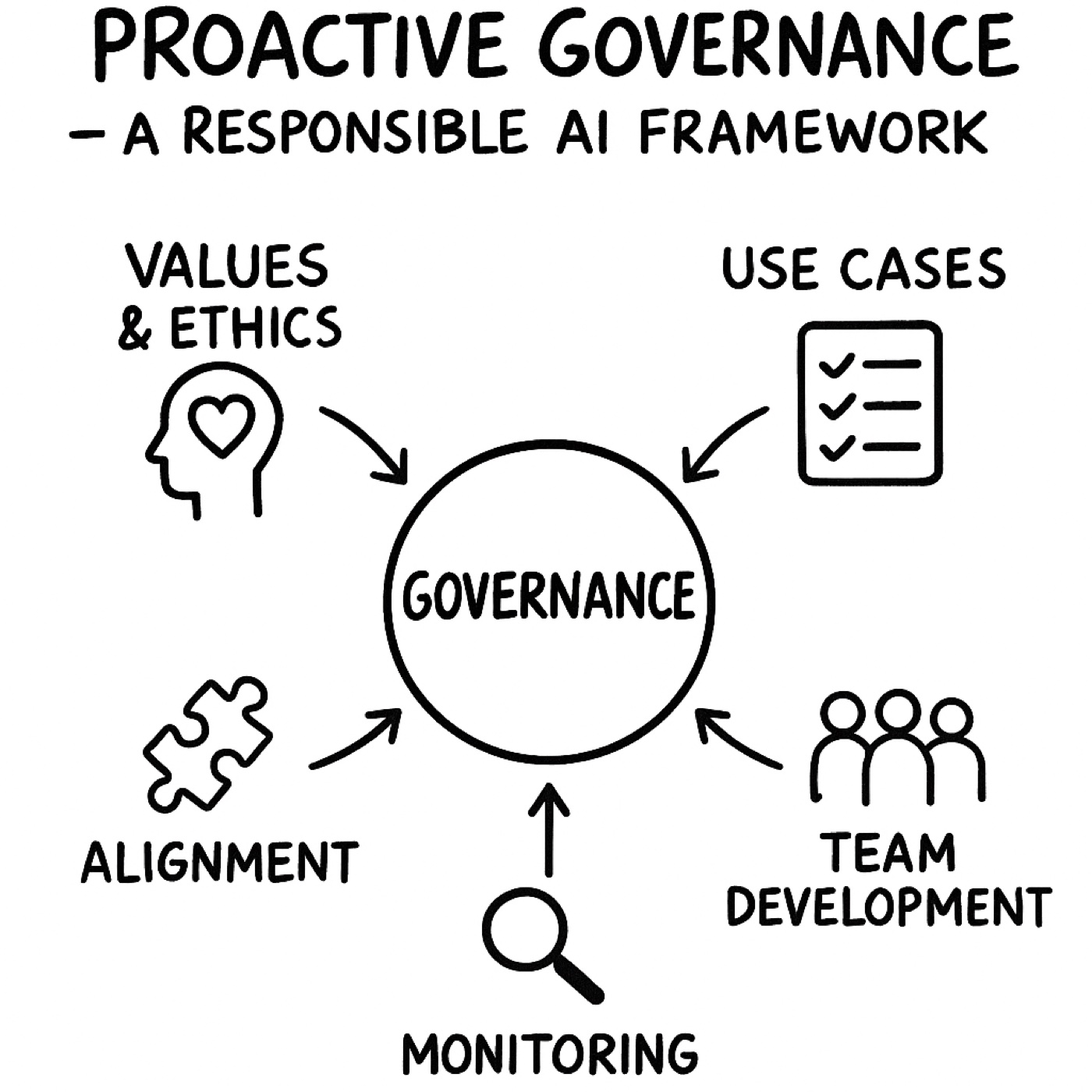
The framework positions governance not as an afterthought but as the ethical and strategic spine of AI adoption. It brings together values and ethics, use cases, organisational alignment, monitoring and team development, helping teams think through the risks, safeguards and responsibilities attached to AI‑enabled communication and engagement.

In practice it supports decision‑making by helping staff identify appropriate use cases, weigh potential risks and establish clear routes for review and accountability — embedded across ethics, strategy, evaluation, leadership and clinical alignment.

Diagram titled 'Proactive Governance – A Responsible AI Framework'. Five elements point inwards to a central circle marked Governance: Values & Ethics, Use Cases, Alignment, Monitoring, and Team Development.
The five elements of the proactive governance framework.

Digital strategy · Higher education

Digital Strategy for Education

Embedding AI literacy across the academic portfolio

  • ContextDe Montfort University, London Campus
  • OutputThree‑point digital strategy; Pedagogy‑Technology Toolbox; Scaffolded AI Integration Approach
  • ThemesAI literacy, curriculum design, sustainability, employability
  • CurriculaMSc Responsible Data Analytics; MSc Cyber Security & AI; Global Cities MBA

This work focuses on how universities can embed AI literacy, digital capability and responsible technology use across programmes in a coherent and practical way. Rather than treating AI as a standalone topic, it integrates AI and digital skills across curriculum design, assessment, staff development and student learning.

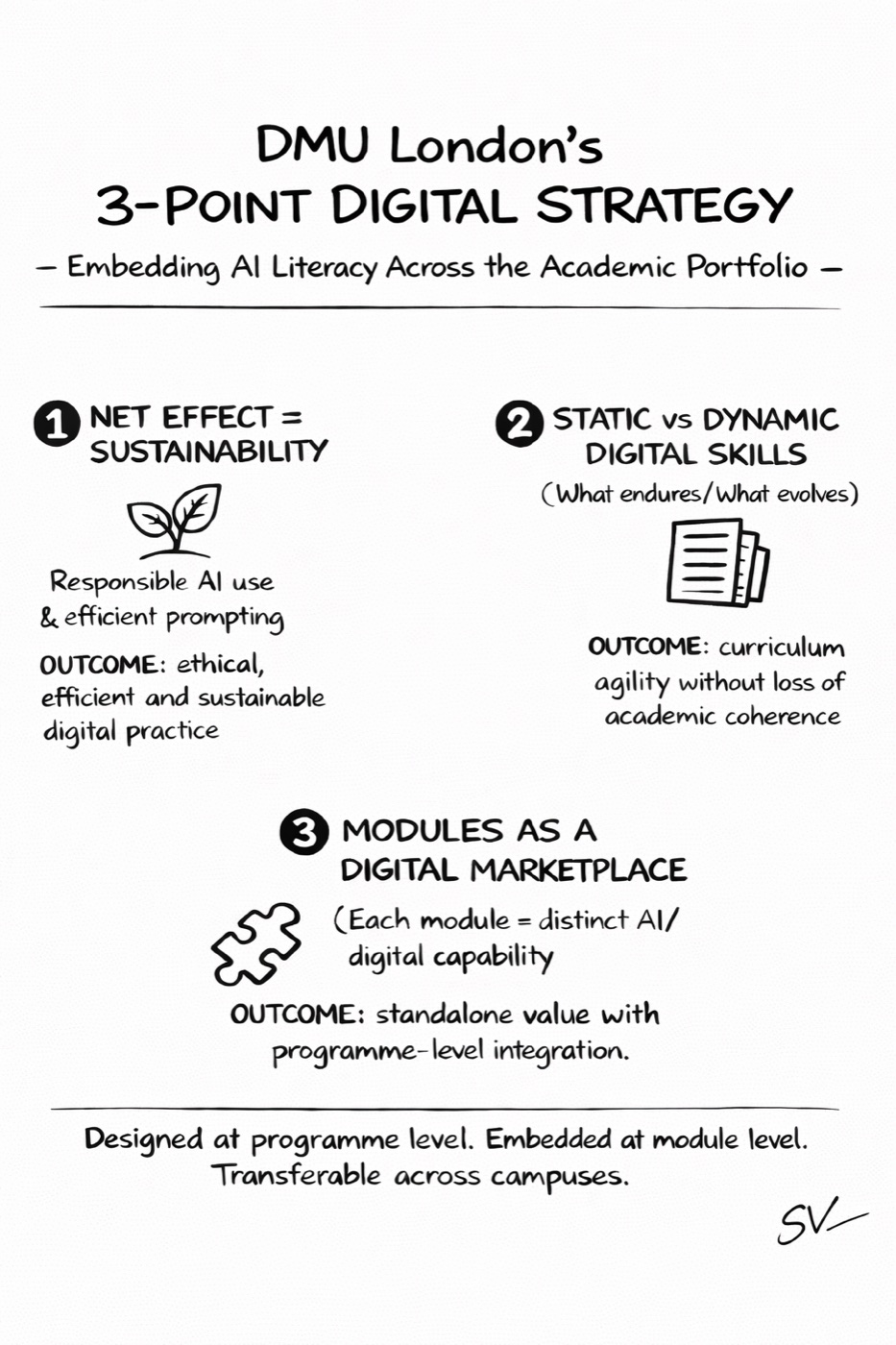
Three points

1. Net Effect = Sustainability. Encouraging responsible AI use and efficient digital practice, including better prompting and more thoughtful engagement with digital tools. The outcome is ethical, efficient and sustainable digital practice.

2. Static vs Dynamic Digital Skills. Helping programmes distinguish between skills that endure and skills that must evolve as technology changes. The outcome is curriculum agility without loss of academic coherence.

3. Modules as a Digital Marketplace. Positioning each module as a space where students develop a distinct AI or digital capability, while still contributing to programme‑level coherence. The outcome is standalone value with programme‑level integration.

Designed at programme level, embedded at module level, and transferable across campuses. The approach also connects digital capability with sustainability, employability and responsible innovation, and has informed curriculum development in areas such as Responsible Data Analytics, AI and Cyber Security.

Hand-lettered poster titled 'DMU London's 3-Point Digital Strategy — Embedding AI Literacy Across the Academic Portfolio'. Point one, Net Effect equals Sustainability, covers responsible AI use and efficient prompting. Point two, Static versus Dynamic Digital Skills, distinguishes what endures from what evolves. Point three, Modules as a Digital Marketplace, treats each module as a distinct AI or digital capability. The footer reads: designed at programme level, embedded at module level, transferable across campuses.
The three‑point digital strategy for embedding AI literacy across the academic portfolio.

Mental health literacy · Professional development

MindfulConnect

Digital professional development for mental health literacy

  • AudienceHealth and social care professionals
  • FundingDMU Higher Education Innovation Fund (2025)
  • FormatCo‑developed, online, interactive CPD programme
  • ThemesMental health literacy, culturally sensitive support, accessible learning design

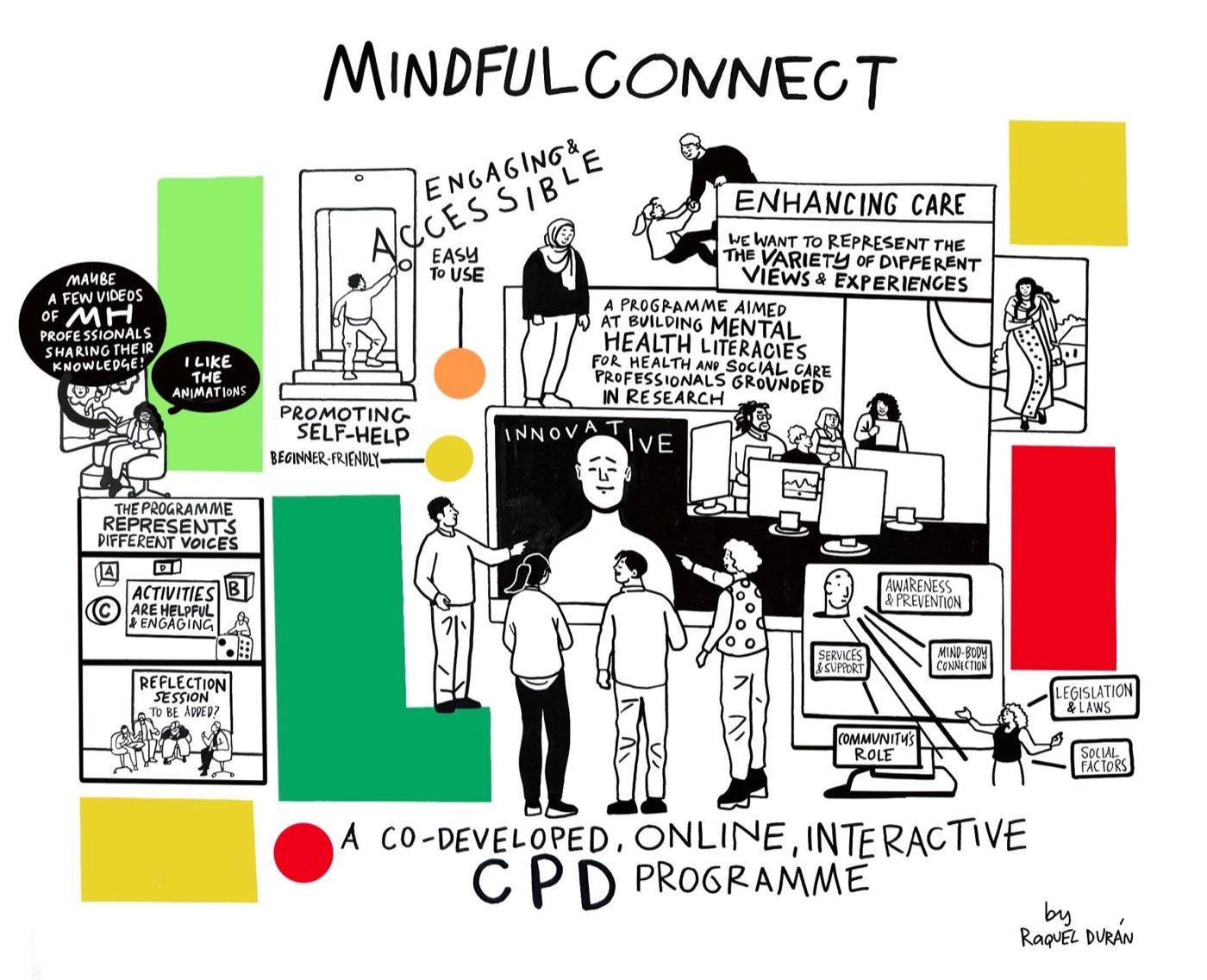
MindfulConnect is an interactive online professional development programme designed to strengthen mental health literacy among health and social care professionals. It focuses on creating accessible, engaging and practice‑informed learning that supports frontline workers in understanding mental health, wellbeing and culturally sensitive support.

The programme was developed as a bespoke digital learning intervention, combining educational design, mental health literacy and professional development. Its structure covers awareness and prevention, the mind–body connection, services and support, the community’s role, legislation and social factors — and it was built to represent a genuine variety of views and experiences.

It sits within my wider research and innovation work on AI, wellbeing and community support, connected to funded activity on mental health literacies for social and health care workers.

Illustrated sketchnote summarising MindfulConnect: a co-developed, online, interactive CPD programme aimed at building mental health literacies for health and social care professionals. Labels describe it as engaging and accessible, easy to use, beginner-friendly, innovative and representative of different voices, covering awareness and prevention, the mind-body connection, services and support, the community's role, legislation and laws, and social factors.
MindfulConnect programme sketchnote by Raquel Durán.

Smart cities · Public engagement · Alan Turing Institute

Leicester Smart City

Community reporters, civic voice and the ethics of urban technology

  • FunderThe Alan Turing Institute (2022)
  • PlaceLeicester and the surrounding region
  • OutputCommunity Reporter Toolkit; podcasts and community radio

This public engagement project worked with people in Leicester from a wide range of backgrounds and underrepresented groups to expand public knowledge and unbiased information around technology, data science and AI. The objective was to enhance connectivity among the people of Leicester — digital, physical and social — while transforming neighbourhoods into nurturing and inclusive communities.

Engaging a wide array of individuals and communities was essential: without it, there is a real risk of widening inequality within the city and its surrounding region.

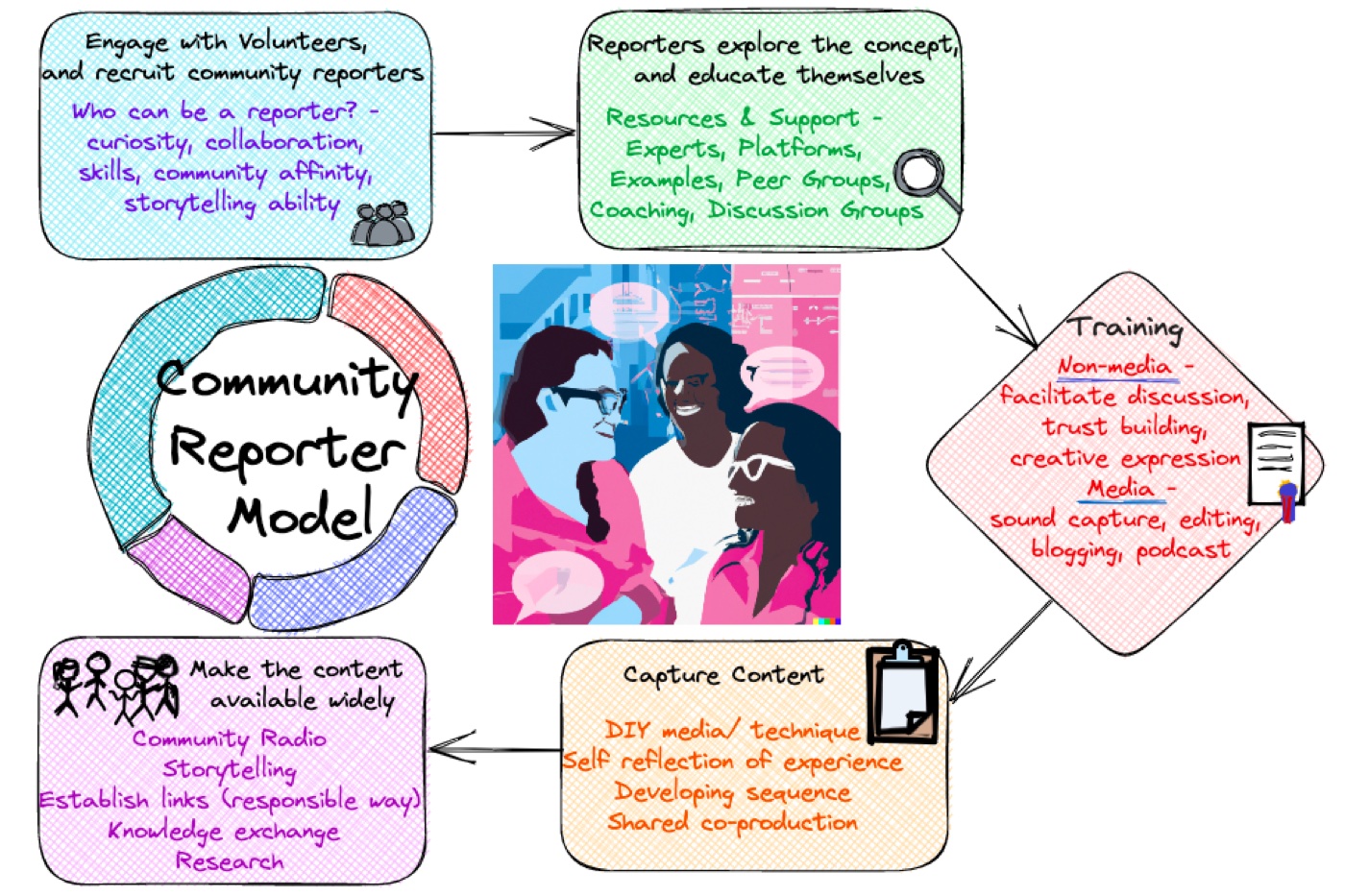
The work involved supporting and training a new generation of community reporters, who used podcasts, community radio and ‘wicked problem solving’ to hold wider and better‑informed discussion around smart cities. Through community reporting club sessions, participants gained skills in creating podcasts, videos and news reports — learning the art of investigating, designing and crafting stories that resonate with people’s lives and experiences.

The project produced a Community Reporter Toolkit on how to work together to manage change when building smart cities, with the key message: if you want tech to be right, bring inputs from community.

Listen to the community reporters’ podcast on smart cities, social challenges and AI ethics →

Cycle diagram of the Community Reporter Model with five stages: engage with volunteers and recruit community reporters; reporters explore the concept and educate themselves with resources and support; training in both non-media skills such as facilitating discussion and trust building and media skills such as sound capture, editing, blogging and podcasting; capture content through DIY media and shared co-production; and make the content available widely through community radio, storytelling, knowledge exchange and research.
The Community Reporter Model developed through the project.
Two community reporters wearing headphones and holding microphones, recording a podcast outdoors in front of a brightly coloured graffiti mural.
Recording with community reporters in Leicester.
Also in progress

Further strands

AI safety · Safeguarding

Testing the guardrails

Simulating real‑life conversations to probe generative AI models for vulnerabilities in current safeguarding approaches, and producing an AI Safety Stepwise Checkpoint outline.

Read the working papers

Sustainability · Campus operations

Operationalising carbon literacy

Leading the design of an AI‑driven tool that brings carbon literacy into campus management systems by managing the carbon footprint of business as usual.

Student voice · JISC

International Student Digital Experience

Co‑lead on a JISC project working with undergraduate and postgraduate international students across the university to understand their digital experiences and perspectives.

Data literacy · Local government

How users read data tools

With East Midlands Chambers of Commerce, the Leicester and Leicestershire Enterprise Partnership and Leicester City Council — investigating how users interact with data tools and whether they draw correct inferences.

Collaboration

Interested in working together?

I am open to research collaborations, commissioned evaluation, AI governance advisory work and participatory research partnerships.