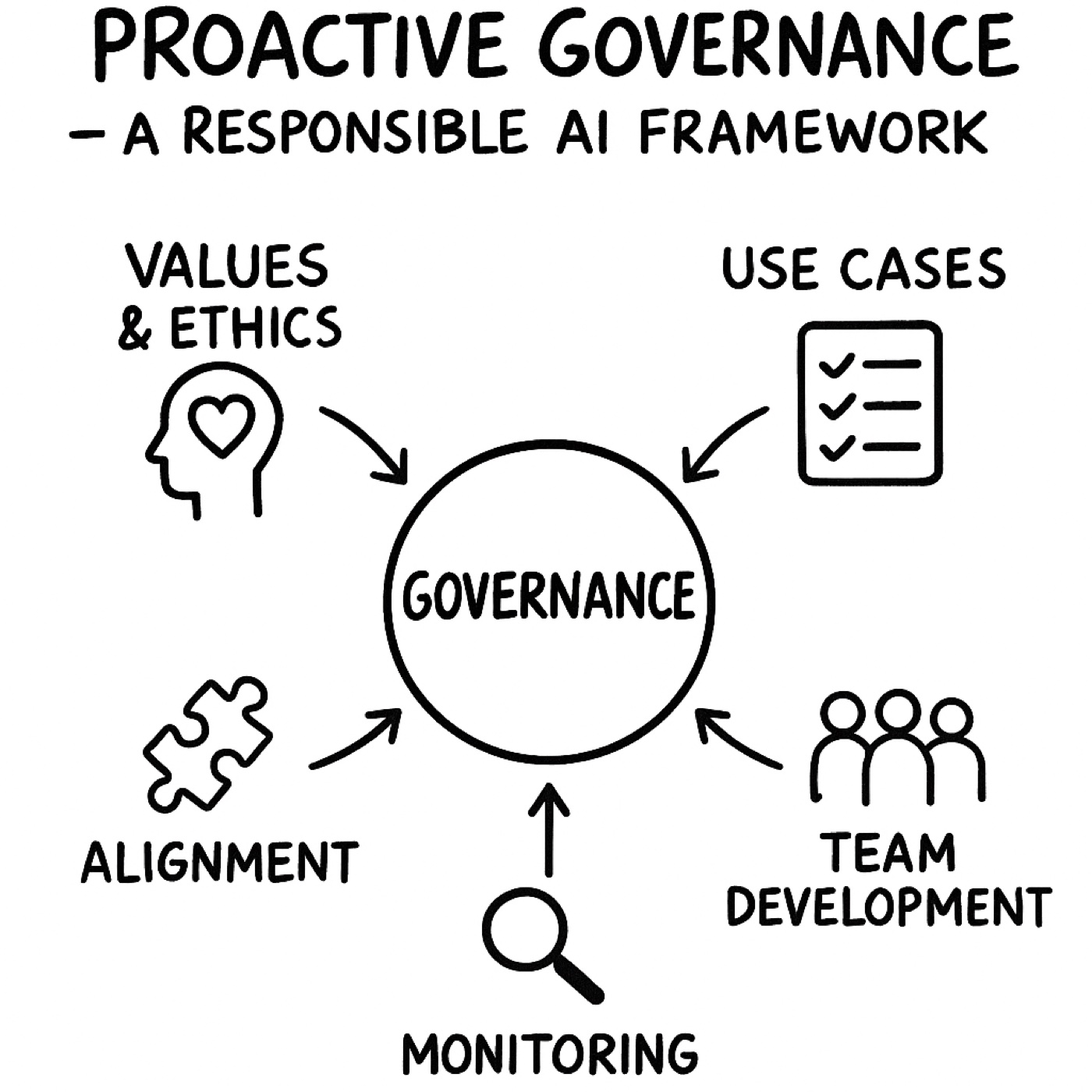
Proactive Governance
A responsible AI governance framework built around five elements — values and ethics, use cases, organisational alignment, monitoring, and team development. Developed with University Hospitals of Leicester NHS Trust.
NTF · PhD · SFHEA
Head of Academic, De Montfort University, London Campus
National Teaching Fellow
I work at the intersection of AI, ethics, education and social impact.
My work helps universities, public bodies and professional organisations adopt technology in ways that are ethical, inclusive and operationally useful — protecting human agency, building trust and making sure the benefits of digital innovation are distributed fairly.
How can learning, technology and collaboration help build more inclusive, ethical and human‑centred futures?
I am Head of Academic at De Montfort University, London Campus, where I lead the academic, international support and partnerships workstream. I led the strategic launch of the campus — embedding inclusive education, sustainability, employer partnerships and AI‑driven initiatives such as the bespoke EDGE skills‑development programme and the London Career Development Service. My portfolio leadership includes the Global Cities MBA, designed for shared delivery across the London and Dubai campuses.
In 2026 I was awarded a National Teaching Fellowship, the UK’s national recognition for excellence in teaching and learning in higher education. I am also a Senior Fellow of Advance HE and hold a Doctorate in Economics from the University of Manchester.
Before my current role I was Senior Lecturer in Economics and Deputy Director of the DBA programme in De Montfort University’s Faculty of Business & Law, and have previously worked at the University of Huddersfield, Lancaster University Management School, the University of Manchester, and the Institute of Economic Growth in India — a path that has given me both a quantitative research background and a practical understanding of how institutions actually change.
My work spans eight connected areas of academic leadership:
My research focuses on the societal impact of artificial intelligence, particularly how AI can be designed, governed and used responsibly. I am interested in the practical questions that sit behind AI adoption: how do we protect human agency, build trust, reduce inequality, support wellbeing, and ensure that technological progress leads to genuine public and social good?
I specialise in the strategy and operations of Responsible AI — the work of turning principles into frameworks, decisions and everyday practice. I have authored three national reports for the UK’s Chartered Institute of Public Relations on AI adoption, skills readiness and task penetration, and I advise public‑sector, professional and civic partners on responsible AI approaches that are ethical, inclusive and operationally useful.
Alongside my research, I am deeply committed to pedagogical innovation. I design creative, digital‑first and student‑centred learning environments, with a particular focus on responsible AI, employability, sustainability and inclusive practice. My work includes curriculum design, academic staff development, enterprise education, AI literacy, and the use of playful and participatory methods to support deeper learning. Pedagogical adaptability is my forte, along with creative approaches to instructional design.
My research explores how AI and digital technologies can contribute to social good while remaining grounded in ethical, inclusive and human‑centred principles. I am particularly interested in how responsible AI can help address socio‑economic challenges, reduce inequalities and ensure that the benefits of technology are distributed more equitably.
A central focus of my current work is the development of culturally sensitive and human‑centred AI interventions in areas such as mental health, communication and digital media. This includes research on responsible AI governance, AI literacy, digital inclusion, and the role of ethical design in shaping trustworthy technological futures.
My work spans a range of applied and interdisciplinary projects — from engaging communities in the design of smart cities, to evaluating the impact of virtual GP consultations, to developing AI‑enabled tools for mental health literacy and civic engagement. Across these projects I take a bottom‑up and participatory approach that prioritises lived experience, inclusion and the needs of underserved communities.
At the heart of it is a commitment to ensuring that digital innovation supports human agency, strengthens communities and contributes to more inclusive, ethical and socially responsive futures.
Principles only become useful when they are operational. These are the frameworks and programmes I have designed for universities, public‑sector teams and professional bodies.
A responsible AI governance framework built around five elements — values and ethics, use cases, organisational alignment, monitoring, and team development. Developed with University Hospitals of Leicester NHS Trust.
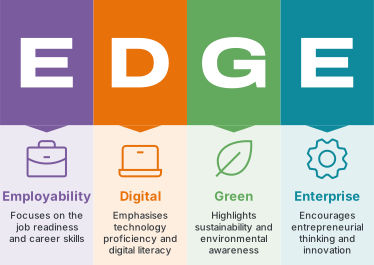
A six‑week skills‑development programme running alongside the academic schedule, structured around four tracks — Employability, Digital, Green and Enterprise — and built towards a capstone project, a certificate and a digital badge.
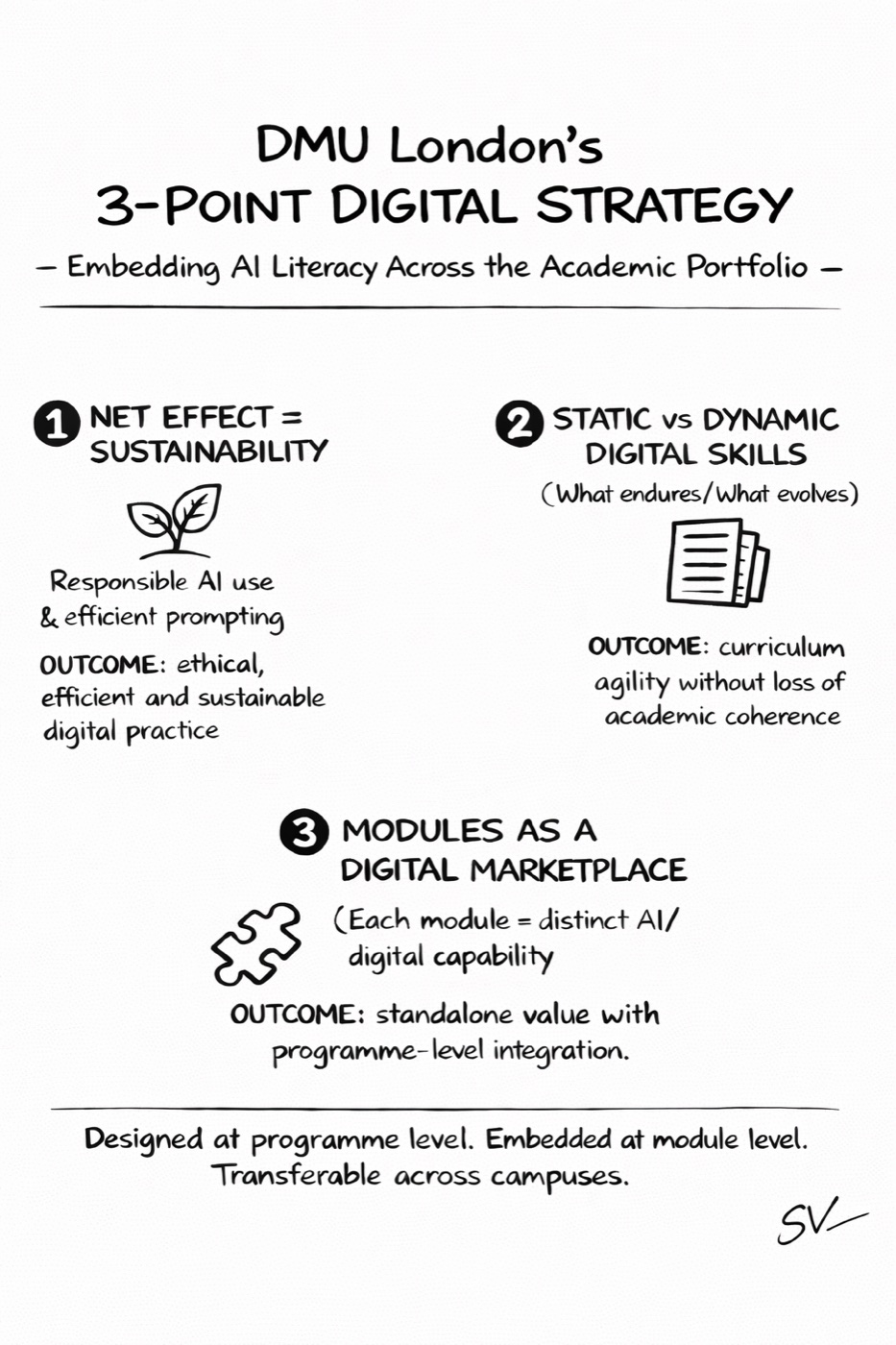
How a university embeds AI literacy across a whole academic portfolio — designed at programme level, embedded at module level, transferable across campuses.
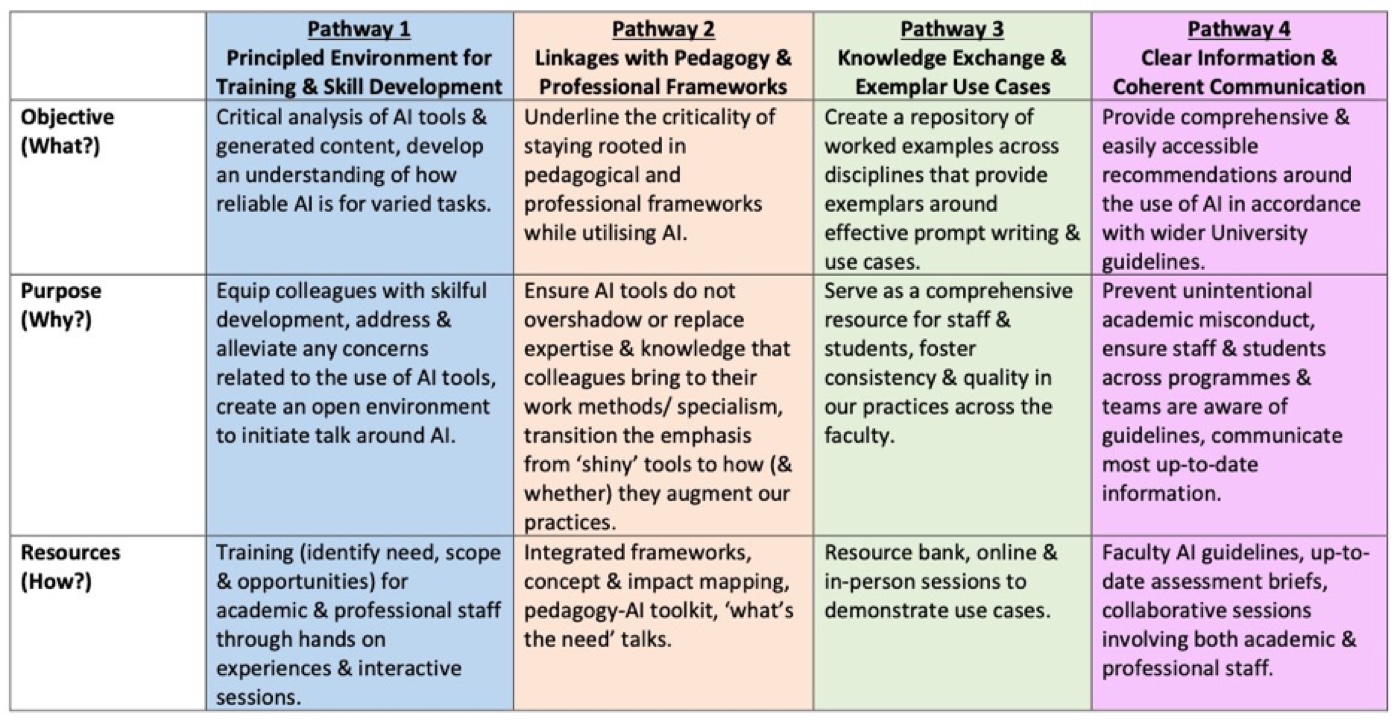
A faculty‑wide approach across four pathways, each with a defined objective, purpose and resource set — from staff training to assessment guidance.
Applied work with partners in healthcare, charities, professional bodies, local government and higher education.
An intelligent survey agent that reimagines data collection as a two‑way adaptive dialogue rather than a static form. Piloting with RAFT, a Leicestershire charity supporting parents and carers of care‑experienced children.
Read about SCOPE‑AIA proactive governance framework for the Communications and Engagement Directorate at University Hospitals of Leicester, positioning governance as the ethical and strategic spine of AI adoption.
Read about the frameworkEmbedding AI literacy and digital capability coherently across an entire academic portfolio — through curriculum design, assessment, staff development and student learning.
Read about the strategyA co‑developed, online, interactive CPD programme building mental health literacy among health and social care professionals, grounded in research and designed for accessibility.
Read about MindfulConnectAlan Turing Institute‑funded public engagement work training a new generation of community reporters to hold informed, inclusive discussion about smart cities, data and AI.
Read about the projectMeasuring the impact of MedicSpot technology in GP consultations, and assessing the economic impact of the coronavirus pandemic for Leicester.
See the reportsProject Lead · DMU Higher Education Innovation Fund
An interactive, online professional development programme on mental health literacies for social and health care workers.
Project Lead · DMU Mary Seacole Research Centre
SCOPE‑AI — advancing mental health literacy with a culturally sensitive AI agent that evaluates social stigma and addresses inclusivity gaps.
Project Lead · Knowledge exchange with Residential Management Group
A bespoke, client‑focused MSc Property Management & Investment programme.
Principal Investigator · ESRC Accelerator Scheme
Leveraging a customised GPT to address barriers to mental healthcare and wellbeing among young adults.
Co‑Investigator · Higher Education Innovation Funding
With East Midlands Chambers of Commerce, the Leicester and Leicestershire Enterprise Partnership and Leicester City Council — investigating how users interact with data tools and draw correct inferences.
Co‑Investigator · The Alan Turing Institute
Engaging the Community in Designing a Smart City.
Co‑Investigator · Willows Medical Centre, Leicester
Measuring the impact of Medicspot virtual GP consultations.
My work is built around partnership — with health services, charities, professional bodies, industry, local government and universities.
Invited speaker · CIPR & CISION
Panel · AI for PR Conference 2026, Communicate Magazine, supported by CIPR and PRCA
Workshop · UCL and the Royal Economic Society
Seminar · Government Economic Service, HM Treasury
Delivered to a membership of more than 3,500 economists across UK government departments.
I collaborate with three kinds of partner. If your work sits in any of these areas, I would be glad to hear from you.
For institutions embedding AI literacy and digital capability without losing academic coherence. I chair academic quality and governance committees and mentor colleagues towards Advance HE Fellowship.
For teams that need AI adoption to be innovative and efficient while remaining transparent and accountable. Recent work includes national CIPR reports and a seminar for the Government Economic Service at HM Treasury.
For leaders building smart and digital places that residents actually trust and use. Delivered with Leicester City Council, the Leicestershire Enterprise Partnership and the Alan Turing Institute.
I am open to research collaborations, advisory and governance work, keynote and panel invitations, and staff development partnerships.